Showing posts with label wild flowers. Show all posts

Friday, 26 August 2016

Butterflies And Gall Wasps

Some miscellaneous spots from the last week:


This is the gall of the Bedeguar Gall Wasp, which lays it's eggs in a branch of dog rose (Rosa canine, a native wild rose) and in what Wikipedia describes as 'a way not yet understood', causes the gall pictured here to develop.  Joking aside, the page is quite in depth and interesting: https://en.wikipedia.org/wiki/Diplolepis_rosae


Meanwhile, I spotted this rather tatty looking Red Admiral feasting on some red valerian in my parent's garden, which was decent enough to stay still long enough to allow me to get my camera out and focused.


Saturday, 20 August 2016

Chalk Downland Flowers Spotter's Guide Part One: Purple Flowers

My own, completely arbitrary, guide to telling apart flowers of chalk downland. I'm going by colour first. Basically, chalk downland flowers are all going to be either purple or yellow and then there's a third category of flowers that are neither purple nor yellow. We may get round to yellow and neither purple nor yellow in good time. Maybe.

Just a quick reminder before we go on: chalk downland is generally poor, not very fertile soil and so for that reason suits the flowers listed below. (See http://punkrockecology.blogspot.co.uk/2016/06/over-hills-and-far-away.html for a short description of chalk downland, or click on' chalk downland' in the labels box to the right).

Anyway, here we go:

Knapweed


Greater Knapweed (Centaurea scabiosa) This is similar to a thistle. I was going to say it was a member of the thistle family but to be properly botanical, it's a member of the daisy family (Asteraceae), which is a pretty substantial family in itself. Knapweed, is part of the genus Centaurea or knapweeds and star thistles, which are thistle-like in appearance but lack actual thistles. Check out the unopened flowerhead to the left, which is very thistle-like in appearance.

A quick dichotomous identity test goes as follows:  does it look like a thistle? If yes, grab it with your bare hand. Does it hurt? If no, then it is part of the genus Centaurea. 

Finally, if it's big and purple then it's greater knapweed (Centaurea scabiosa). If it's smaller and purple then it's common knapweed (Centaurea nigra).  


Devil's Bit Scabious


Devil's Bit Scabious (Succisa pratensis). Similar to knapweed in colour and globular shape but smaller and of a lighter purple, and blending delicately to a white centre. Also note the very prominent stamen's standing proud of the florets. (Translation: the tiny stalks sticking out of the flowers). The whole flower is made up of dozens of tiny little individual florets (pay attention to them, that'll be important with identifying the next flower).

It is part of the much smaller teasel family (Dipsacaceae), despite looking nothing like a teasel. The stem is long and spindly and slightly fuzzy.

According to the latest newsletter of the Dorset Wildlife Trust, the name 'devil's bit' comes from a tale that the devil was jealous of such a pretty flower so bit off it's root out of spite. Or something. Now, that sounds like a load of old cobblers to me: some story an old farm hand made up and told to a victorian flower collector over a few pints of cider. But that's none of my business.


Field Scabious


Field Scabious (Knautia arvensis). Very similar, in fact broadly identical, to devil's bit scabious. The species name is completely different but I've no idea why. It is similar in being a similar paste shade of purple and with the same prominent stamens but, instead of a hemispherical shape, it's flatter and has 'corners', like a four or five pointed star. These are all made up of little florets, like the devil's bit, but these flatten out towards the edges - tight, round and closely packed in the centre but larger and flatter towards the edge.

But don't take my word for it. Here's the always reliable Wikipedia, with a full run down of species classification and everything:

Greater knapweed: https://en.wikipedia.org/wiki/Centaurea_scabiosa

Devil's Bit Scabious: https://en.wikipedia.org/wiki/Succisa_pratensis
and http://www.wildlifetrusts.org/species/devils-bit-scabious

Field scabious: https://en.wikipedia.org/wiki/Knautia_arvensis and http://www.plantlife.org.uk/wild_plants/plant_species/field_scabious

What a stamen is, in case you were wondering. Though I'm thinking that you really should have had birds and bees explained to you by now: https://en.wikipedia.org/wiki/Stamen https://www.amnh.org/learn/biodiversity_counts/ident_help/Parts_Plants/parts_of_flower.htm


Sunday, 24 July 2016

Bog Asphodel and Sundews

More pics from the same bog. Here's some bog asphodel (Narthecium ossifragum) in full flower.

Some sundews (Drosera rotundiflora) on a bed of sphagnum moss


And a nice panoramic view of a the same mire in full flower. As I mentioned a couple of posts ago, most of my experience on heathland has been in the winter, when it's all brown and kinda bleak looking, so this comes as a pleasant surprise.


Wednesday, 20 July 2016

Ask Not For Whom The Bell Heather Tolls...

We're out checking the cows on one of our sites, which was another bit of former heathland pine plantation.  'Checking the cows' involves counting them - none of them have either died, wandered off or given birth - and then giving them a quick visual once over for any obvious signs of injury or illness.


As we ride around the site, I spot a profusion of beautiful purple flowers. Looking around, they seem every where but I don't know what they are. So, I do what I normally do and get my phone out, take a picture and look it up in my wildflower book.


It's a very distinctive flower. I'm not going to say what I thought they looked like at the time, you'll have to use your own imaginations for that, but anyway I looked it up aaaaand it was....


.....bell heather. Yes, bell heather (Erica cinera). With one winter's experience working on Holt heath and two on Godlingston and Studland heaths, plus studying heathland as part of my course I fail to spot one of the commonest heathland plants and one that I've been walking over for years. Oops.

In my defence, all my heathland experience has been in the autumn, winter and spring. At that time of year, heathers are all a nondescript, unhealthy looking brown and you're usually stepping over them to get to the five foot tall, spiky, green and vibrant yellow gorse bushes. But still...


Saturday, 9 July 2016

More Extreme Orchid Spotting


Spotted on the roundabout outside Blandford. A common spotted, I think (Dactylorhiza fuchsia) I believe that this area was seeded with wild flowers a few years ago, unlike the previous roadside orchid spot on the Isle of Harris(http://punkrockecology.blogspot.co.uk/2016/06/more-orchids-morchids.html), which was a genuine wild flower in an actual wilderness!

Wildflowers by roadside seems to be the new thing and, although I used to be one of the people who's job it was to mow roadside verges a few years ago, I believe that this is very much a good thing.

More here: http://www.plantlife.org.uk/our_work/campaigns/flowersontheedge/roadvergeexamples

Sunday, 26 June 2016

More Orchids. Morchids.

When I said a couple of posts ago that orchids just litter the roadside around here: here's a fairly extreme example of that.


This is a common spotted orchid (Dactylorhiza fuchsii) which, as the name suggests, is one of Britain's commonest wild orchids. The roadside that I spotted it next to was the main road between Stornaway in the Isle of Lewis and Tarbert in Isle of Harris. Technically, they're the same island - as in there is no water between them - but while Lewis is predominantly flat, Harris is not. The road winds up the side of a mountain over looking Loch Seaforth and we stopped to admire the view. 


You can't blame us, really, can you? Harris makes Lewis look like the garden of eden. This, we joked, was 'troll country' and were listening to Norwegian band Wardruna just to add to the effect.

I went for a short wander up the hillside and spotted this little beauty on the marshy soil. Photographing the picture at the top came at the expense of my knees, kneeling in the damp bog but I think it was worth it.


Still more orchid pictures to come.
The Common Spotted Orchid http://www.wildlifetrusts.org/species/common-spotted-orchid

Wardruna. The song's about Odin and sung in old Norse.


Thursday, 23 June 2016

Pretty Pictures Of Flowers


In yesterday's post, I mentioned 'matter', which was the 'fertile plain' between the alkaline sea and the acid moor? Well here's an example of that. The yellow-ochre patch to the right is seaweed and I'm afraid I don't know a damn thing about seaweed so can't help you on that. To the left is grass (I'm guessing marram grass) and the pink flowers are thrift (Armeria mafitma). Thrift is tolerant of salty sea water - I've seen it quite happily living underwater in a nearby loch - and so can handle the occasional high tide.


This is the same patch of land, showing the large tussocks and the channels of water running between them. The area is prone to very violent winter storms, and these patches are built on tiny patches of earth on a bed of very tough rock. The rock in question is lewisian gneiss, which is a type of granite and igneous, if you remember your geology from school. Some of the oldest rocks in the British Isles apparently, although I thought they were all pretty old.

Now, moving inland, the place where we are staying comes with a croft, which is a patch of land that comes with the house and is intended for agricultural purposes. It is used occasionally for agricultural purposes - specifically grazing sheep. However, a quick jaunt around provides some surprising finds. Not just the northern marsh orchids as described in the previous posts (I've counted six in the immediate garden of the house alone) but such beauties as these:


This is Red rattle (Pedicularis palustris) or marsh lousewort, which was very prolific on the site. This is a 'hemi-parasitic' plant, which attatches it's roots to the roots of nearby grasses and 'borrows' water and mineral salts. Back down south, it  and it's cousin yellow rattle are often sewn into fields to improve biodiversity, as the grass there would otherwise crowd out everything else. Here, it just grows of it's own accord in a scrubby, rush infested bit of sheep grazing land.


According to the 'Reader's Digest Field Guide To Wild Flowers of Britain', which I found on the shelf here, it got the name 'lousewort' from a theory that it infected sheep with lice. However - and again according to the same book - lousewort is popular with snails and snails are carriers of liver fluke, which can infect sheep. Unhealthy, liver fluke stricken sheep would have been prone to catching lice and then spreading lice through the rest of the flock. Happily for sheep, shepherds and wildflowers, sheep are inoculated against liver fluke these days.


This is a round-leafed sundew (Drosera rotundifolia), which is a carnivorous plant. The leaves are covered in red hairs, each of which is covered in a droplet of sticky liquid. Midges mistake them for water and get stuck, where upon the leaf curls inwards and the insect is digested. Like all carnivorous plants, it also photosynthesises, so the insect-eating is an addition to, rather than a replacement for, the actual nutrient factory of photosynthesis. Chomping the occasional insect allows the plant to thrive on a highly acid bog with very few essential plant minerals.  

So there you go. There's more, much more but we'll get round to that presently.

Wednesday, 22 June 2016

Orchidorama

Just to get everybody up to speed, I'm on holiday on the Isle Of Lewis in the outer Hebrides at the moment and am keeping my eye open for anything interesting. We'd already spotted porpoises, jellyfish and a dead monkfish before we'd even got there and, on arrival, we were not disappointed!


The western Isles, which are a very remote, wet and windswept place are renowned for their machair, or beds of wildflowers. This is from the gaelic for 'fertile plane' and represents a flat bit of coastal land, stuck at a fairly neutral pH level between the alkaline sea and the acid bog of the inland.

To expand briefly on that, all soil is either acid, neutral or alkaline. Soils such as chalk, which is the predominant soil type down where I live on the south coast, are alkaline while "good" soils tend towards either neutral or very slightly acid. It's one of those things you get a lot in ecology, where a healthy soil helps maintain a healthy soil. Plants die and are eaten by various critters, down to and including microbes, which creates a rich hummus that is ideal soil for plants to grow in.

It's one of those weird, chicken and egg type situations, where perfect harmony is perpetuated somehow. However, in some places, heavy and persistent rain will wash all these nutrients out of the soil. The western isles are all about heavy and persistent rain. And wind. This makes the soil very acid indeed and, as we know acid and microbes do not get along very well. The rain washes nutrients from the soil, making the soil more acidic, which inhibits microbial life in the soil and microbial life is basically the bottom of the pyramid that all life rests on. Without it, nothing happens.

Last time I was up here, it was February 2015 and I was moving stones around amongst other things. Down south, even in February, when you moved a stone, lots of little critters like woodlouse and centipedes would scurry out of your sight but here... nothing. Not even worms. It was one of the best illustrations of a line in a text book that I'd ever seen. Without microbes, stuff does not rot and so you get great, springy, squishy matts of peat building up over the centuries. Remove a core from these bad boys and you can bring up seeds going bucket just after the last ice age.


So, just to recap, rain washes out nutrients, creating a highly acidic soil. This creates a difficult environment for most plants - the interior of the Isle of Lewis is not thick with fields of wheat, for example - however, this makes it a just fantastic habitat for plenty of rare plants. Orchids, for example.


The four pictured are in the driveway of the place where we are staying. Just to confirm that: in the place where we are staying, there are at least four wild orchids IN THE DRIVEWAY. The one in the picture above is a good foot high. According to my research, it's a northern marsh orchid, on account of the fact that it looks like one, it's in the north (we're about 20 miles south of the most northerly point in the British isles) and it's on a marsh. Dactylorhiza praetermissa to give a species name, though be warned I am not an expert, just a bloke with a book on wild flowers.


This one was probably a common spotted orchid, although according to this same book, they tend to grow on lime soils, which this very much is not. But putting all that aside, isn't it pretty? And they're all over the place. Literally: you look in a roadside verge and think 'oh, another orchid'. Back home, I got quite excited when I saw a few on a roadside verge that had specifically been planted for wildlife. Here... they just grow.

Anyway, just to wrap up, this is not the machair that I described above. That is mostly buttercups and daisy as far as I can tell. This is on the acid bog that covers most of the island. More to follow... stay tuned.

Wednesday, 1 June 2016

Over The Hills And Far Away

Another day, another nature photography expedition with the missus. This time to Hambledon Hill, an iron age hill fort near Blandford. 
This is classic calcareous grassland. Chalky soil, so alkaline, free draining and with a very thin soil layer. This makes it good wildflower habitat, as we can demonstrate:


This is Bird's Foot Trefoil. Also known as 'bacon and eggs' for some inexplicable reason. Although bird's foot trefoil is hardly the most obvious name either. Also 'granny's toenails', although I'm seriously wondering at this point whether whoever wrote my wildflower ident book was taking the mickey.


This is classic grassland. As mentioned above, due to the thin soil and chalk beneath, it's not very fertile. Basically, if you are grazing cattle and sheep on these hills, there is a limit to how much it can be grazed, as the grass will have to recover. It's all about how many animals you can have on how large a patch of land.
Then some time around the early twentieth century, artificial nitrate fertilisers were invented and suddenly, you could take a patch of thin soil such as this, plough it up and seed it with rye grass or something similar, fertilise it regularly and graze cattle much more intensively. This was called 'improved grassland' and was great for farmers, great for cheap lamb and beef but not so great for wildflowers.


The flowers and plants that had traditionally grown on this sort of soil had adapted to a marginal, very frugal, environment. So, if you then suddenly made that environment less marginal and invited an extremely virulent grass onto the scene, those marginal plants found themselves crowded out.


And so now we roll onto grassland restoration, which attempts to return these areas to their previous species-rich status. It mostly involves not fertilising the soil and maintaining grazing on the land but at a much less intense level. On this evidence, it seems to be working. 

Read more about calcareous grassland restoration HERE

Have a look yourself sometime if you're in the area. It's a beautiful place and has some fine views of the county. Reminds me of a song, in fact.


Saturday, 28 May 2016

Games For May

Out with the dogs and the missus again, this time on the road running past Bradbury Rings. Bradbury  is an iron-age hill fort and, running past it is the main road between Wimborne and Blandford, which runs through an avenue of beech trees. It's a Dorset landmark and looks kinda like the road to King's Landing would if it was a 60mph A road.

The road, the avenue of trees and the broad grass verges are all National Trust owned and looked after by my old work colleague Paul. 
Here's the whole family in one shot. Mrs Zoom to the left, Maeve the Irish bog whippet in the foreground, Emerson the galgo or Spanish Greyhound ahead of Maeve and Mochi the Podenco on the right.


There's a lot of cow parsley about. Or Queen Anne's Lace if you want to be posh. Anthriscus sylvestnis if you want to be really posh.


Some Devil's Bit Scabious (Succisa pratensis) and some cuckoo flower (Cardamine pratensis). And some grass, obvs.


Some hawk's beard, or possibly buttercups or - even posssiblyer - both.


Saturday, 30 April 2016

Hey, Did Everything Just Taste Purple For A Second?


We've been on orchid watch for some weeks now, at a particular grass verge along an main road that we drive down regularly. The patch in question is next to a woodland owned by Dorset Wildlife Trust   and so we can thank them for this particularly beautiful little patch.

The orchid in question is an Early Purple Orchid, (Orchis mascula) which, as well as sounding great in Scottish, is one of those plants that I strongly suspect was named on a Friday afternoon. ("It sprouts early and it's purple. That's good enough, isn't it? Right, let's get to the pub.") To photograph it without accidentally destroying any more more orchids involved walking down the main road, then finding a gap in the traffic to crouch down to take the pic. These are just some of the risks I am prepared to take to to write this blog.

And, having risked certain death on a main road, we may as well nip in for a poke around the woods, with it's carpet of bluebells and wood anemone, plus a fallen oak tree that seemed far too good timber to waste on beetles! Kudos all round to the DWT. If you want to have a look yourself, it's called Ashley Wood and is near Tarrant Keynestone: 

http://www.dorsetwildlifetrust.org.uk/Ashley_Wood_Nature_Reserve.html


Monday, 25 April 2016

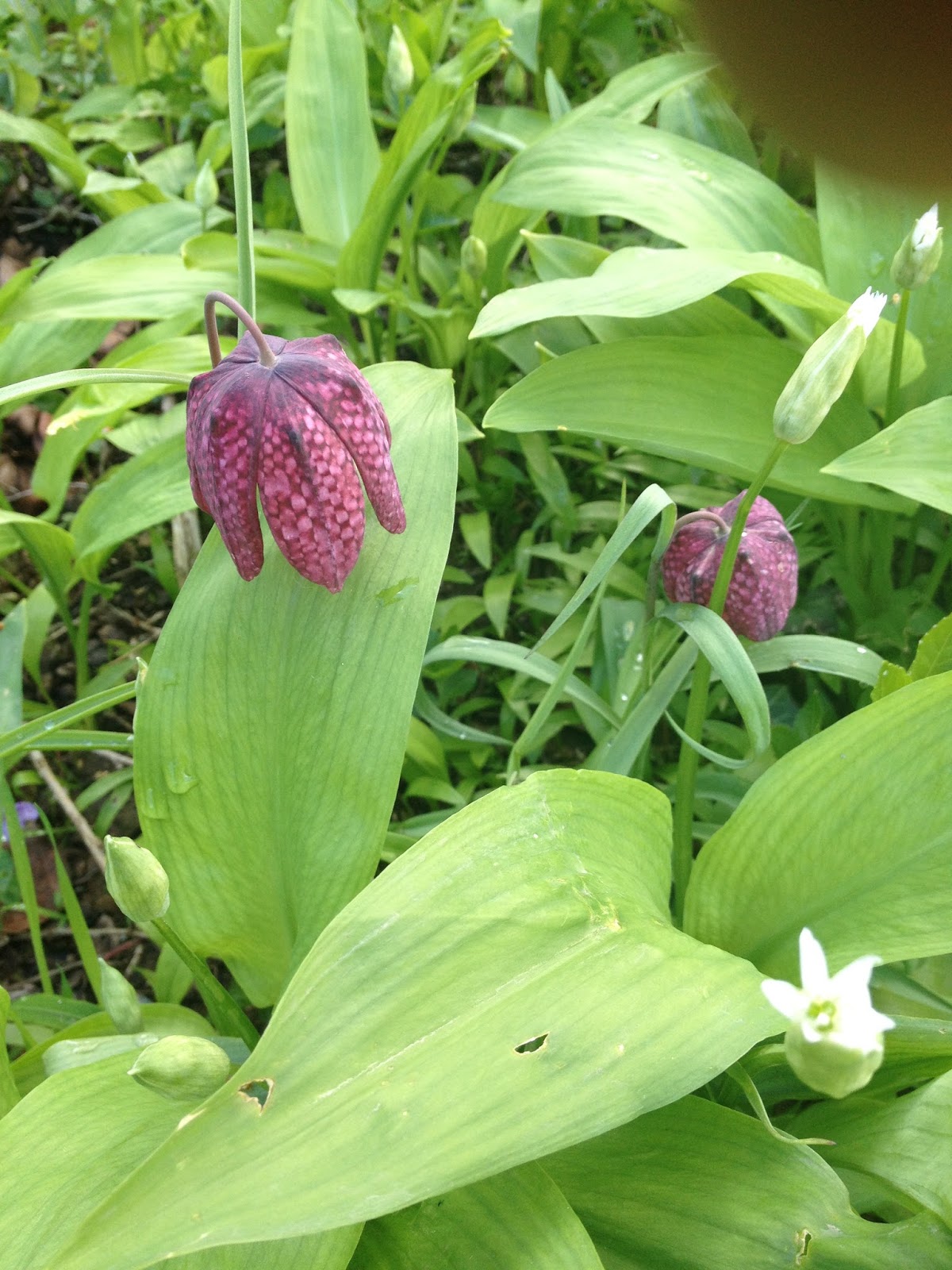
Snake's Head Fritillaries

On the same plant hunting expedition as the bluebells mentioned yesterday, I spotted these snake's head fritillaries, or Fritillaria melagris (See also the wild garlic, or ramsons, in the picture)
probably one of my favourite flowers of all. I'd like to a say favourite wildflower too but, being personally acquainted with the gardener who planted these, I can't claim these as wild. In fact, I don't think I've ever seen one growing 'properly' wild, or in a a situation where they haven't been deliberately introduced. 

I was also going to say about how the 'snake's head' part of their name comes from their chequered pattern, being like a chequerboard or possibly a dice but the ten minute search on google of anything to back up this claim proved fruitless and, ya know, I've got other things to do today apart from blog about flowers.


So yeah, getting to the point, fritillaries were once prolific on meadows across the country and growing happily up in Sweden and Siberia. Now rare, due to these meadows being 'improved' as pasture with nitrate fertilisers, which is great for grazing cattle and horses but not great at all for biodiversity.  Therefore, when you see them now, they've probably been reintroduced as a very pretty addition to a wild looking lawn.

More info (no, seriously, don't take my word for anything):

http://www.kew.org/science-conservation/plants-fungi/fritillaria-meleagris-snake’s-head-fritillary

https://www.rhs.org.uk/plants/details?plantid=814

http://www.dailymail.co.uk/home/gardening/article-1259182/MONTY-DON-A-soggy-spring-drown-tulips-crocuses-daffodils-magnificent-snakeshead-fritillary-thrive-it.html

Sunday, 24 April 2016

A Couple Of Mildly Interesting Things About Bluebells

Now it seems that spring has properly sprung and by golly hasn't everything bounced into life? Bluebells carpet the woods and, while I was wandering lonely as cloud through one of the aforementioned, I was delighted to chance upon an English bluebell. 

So what, I hear you say, aren't they one of the iconic sights of woodlands in the spring time? Well yes but they are now becoming a rare and endangered species and being rapidly wiped out by a hybrid species called the spanish bluebell.

To get all botanical for a moment, we have the english bluebell, or Hyacinthoides non-scripta, pictured below, with it's rather melancholic sideways lean. (Sorry about the rubbish picture btw). 


Then there's the Spanish bluebell, or Hyacynthoides hispanica, which is a much more big and blousey sort of flower, standing upright and really showing the 'hyacinth' in Hyacynthoides.


As with most invasive species, this was introduced as a garden plant and is currently rampaging through the countryside, cross breeding with our native bluebells and producing a hybrid called Hyacynthoides x massartiana.

And you may think 'yeah, and?' I mean, like a lot of people, I was not aware of the difference until it was pointed out to me a few years ago.

But the english bluebell, which as the name suggests, only grows in this country, is in fairly major danger of being wiped out. Some people are up in arms about this. And, certainly, the one pictured above is one of the first that I've seen this year, amongst the carpets of Spanish and hybrid bluebells.

But then, sad though this is, and worthy as the preservation of species is, it is fair to assume that a bumblebee does not give too much of a stuff whether the flower they are pollenating is of the H. non-scripta, the H. hispanica or the H. x massartiana variety. The hybridisation is a problem for english bluebells and various conservation groups but otherwise life in the forest carries on as before.

The carpet of bluebells on the forest floor is not going any where soon, so long as we carry on with the important job of retaining and maintaining these woodlands. But saying that, I will definitely miss the pretty little H. non-scripta with their sorrowful lean and their sweet aroma.

More info: http://www.plantlife.org.uk/about_us/faq/bluebells

http://www.woodlands.co.uk/blog/woodland-flowers/blue-flowers/bluebells/