Showing posts with label chainsaw. Show all posts
Wednesday, 8 June 2016
Rock, Paper, Chainsaw
Remember rock, paper, scissors? Well, using a chainsaw is much the same. As we know, rock blunts scissors, paper wraps around rock (I'm not sure how that defeats a rock but hey, I didn't make the rules) and scissors cut paper.
Now, if we were to substitute 'paper' with wood - as paper is made of wood - and 'scissors' with chainsaw we have the following: chainsaw cuts wood, rock blunts chainsaw and wood doesn't necessarily wrap around rock but it does occasionally wrap around a chainsaw.
To explain: we were out crosscutting a load of fallen branches today. To cut a long story short, it was close to the end of a hot day that I'd spent in a pair of thick chainsaw trousers. Most of the work had been completed and the boss (it's a work placement, so I do the majority of the work their for free but he's still very definitely the boss) asked if I could take down the cracked willow to finish the day off.
The cracked willow was a tree that had cracked quite close to the bottom and then regrown as two trunks from the same stump. One of these trunks had cracked again and, despite having a rather ugly looking 6' long tear above this crack, had continued to grow. This is fairly typical of willow, which will push on through pretty much anything that you or the world and it's weather can throw at it.
The place where the willow tree was growing was at a field boundary, with a barbed wire fence on one side and a ditch immediately behind. This left a very small space for me to work in and, if you have ever done a tree felling course, the one thing that they drum into you is that must always have an escape route. Now, between the ditch and the fence and the hawthorn thicket directly behind me, my options for escape were limited to say the least. Vaulting a 5' high barbed wire fence is not ideal at the best of times and especially not in chainsaw trousers.
Anyway, nothing ventured... the next problem was the actual felling of the tree. It had a considerable lean on it in the direction of fall and so I opted for the text book 'dog's tooth cut'., or 'boring' cut. For this, you cut out the wedge in the direction that you want the tree to fall, as is normal in tree felling. This wedge cut, or gob cut or whichever of the many names it has, gives the tree a little clear space to fall into, so that the felling can be nice and safe and controlled. With a normal tree, you would then do a horizontal 'felling cut', leaving a 1' by 1' "hinge" of wood in a nice, controlled, safe felling. However a strong lean in the direction of felling means that there is already a lot of weight in one direction and the trunk is already under a lot of tension. The tree can split before you have cut through. Which is a bad thing. This, as you'll know if you've ever watched 'Axemen', is called a "barber's chair". I'm not sure why it's called that but it's still a bad thing and is particularly likely with a willow.
So, instead you get the nose of the bar (the bar being the thing the chain goes round, the nose being the bit of it that is s'posed to be furthest away from you) and cut with that directly into the wood. A 'bore' cut, y'see? Or a letterbox cut. You bore your way through to the other side and then widen this slit until it is about a third the with of the tree. Then, you do the final cut, 45 degrees down from the edge of the tree to the wood-free space left by the bore cut. And then, bam, the tree comes down.
Of one third of the tree in my case, as there remained the tricky bit still to do. Also, smoke was actually coming off the chainsaw so I decided to walk across the field to get the slightly meatier spare one to finish the job. Once across the field, where all our kit, fuel etc was stored, I inspected the spare chainsaw, then had a quick drink to replenish my fluids and set back off across the field. Arriving back at the tree, I fired the chainsaw back up, surprised that it started so easily, having not been used all day and set to work.
Not long afterwards, it ran out of petrol, which was odd as I'd just checked that it was full. Then it dawned on me that, when I'd stopped to have a drink, I'd put down the new chainsaw, then picked up the old one and carried that over. After a few choice words, I trudged back across the field, swapped chainsaws over then lugged the big one back over to carry on with the task in hand.
There remained the second trunk to cut which, from a safe felling point of view had 'aaaaaaaargh!!!' written all over it. A big split running through it and a big hollowed out centre. I'd cut the other trunk quite high up, so had to cut it again much lower down. This came away as one lump, leaving a crescent shaped, hollowed out, trunk from which the remaining two cuts sprouted. With 1/3rd of this trunk already missing, I did a felling cut from the back and, bam, down this bit came as well.
So, very tricky tree felled safely. I would have been quite smug if I wasn't hot, aching and wanting to get this job over and done with. It was still leaning on the fence, so I had to cut it free. Wire blunts chainsaw although chainsaw also tends to break fence. Basically, don't get the chainsaw anywhere near the barbed wire. Bad things will happen.
Now, the final little twist to the tale is about tension, as the tree is now lying along the ground and, if you cut into it willy-nilly, the branch will 'pinch' the saw and jamming it in place. The chain will not turn, the saw will not cut and there's nothing else to do but switch it off, swear a few times and then trudge back across the field to pick up the other one. Then, fuel it up, walk back across the field and cut the same branch a few inches to one side.
Having finally cut everything away from the fence so that it was all lying on the ground, I decided to quit while I was ahead, pick up both chainsaws and then lug them back across the field one last time. Happily, everyone else was about done for the day and so all we had to do was lug all the kit back to base. Oh and go home, shower, eat, replenish fluids and then go and do my actual job working in a pub for the next five hours.
So, just to summarise: Scissors (chainsaw) beats paper (wood). Paper occasionally pinches scissors. Rock still blunts scissors and barbed wire just plain ruins your day.
Saturday, 21 May 2016
Rhododendron - The Truth
Back once again with the renegade master. Or rhododendron again. The same woods that would take about twenty minutes to amble through, that we have been working in for a good eight days now.
Not that I'm complaining, I am getting paid for those eight days after all so, from a very self-centred point of view, the more the merrier. However I feel I should add some more detail about the rhododendrons themselves, after doing a little research on them.
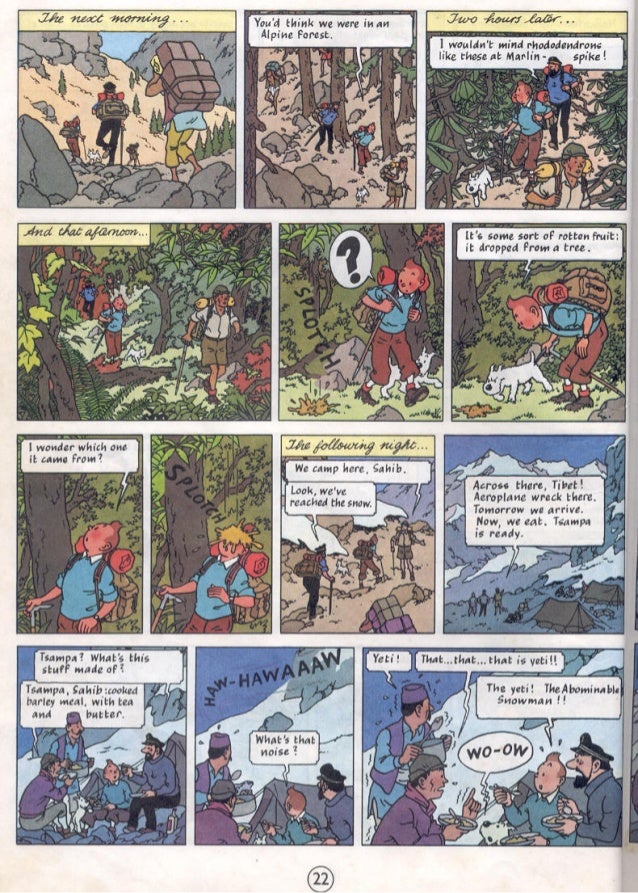
You see, previously, my source material had been mostly hearsay, with the bit about rhodos coming from Nepal being sourced from reading Tintin In Tibet when I was twelve.
Now Tintin is great as I'm sure you'll agree but, a source of cutting-edge botanical knowledge it is not. In fact, it turns out that Rhododendron ponticum is a native to Spain and Portugal, and it was from there that it was introduced to Britain in the 19th century.
The problems with Rhodo are twofold - firstly, it spreads. It branches out from a central core, and then, wherever it touches the ground, a new bush sets root. This is a thing called asexual reproduction and is definitely not confined to Rhododendrons. As an aside, this means that, when you see a wood thick with rhododendron, it is probably all the same plant, i.e. the same plant making genetically identical clones of itself. Annoyingly, as well as this, the plant can reproduce sexually, with the large pink flowers that are in bloom this time of year being fertilised by bees and then producing seeds, which are blown on the wind and sprout from where they settle. I have seen a garden in the outer Hebrides in Scotland - which is just the sort of poor, acidic soil that rhodos love - with a single rhododendron bush in the garden and then a perfectly tear drop-shaped bloom of windblown rhodo saplings growing in the moorland, downwind.
This in itself is not such a problem. There are plenty of species that are a pest - or a complete thug from a gardening point of view - but still part of a healthy ecosystem. Brambles and nettles spring to mind. However, wherever rhodo establishes itself, it will shade out the ground underneath, meaning no light will penetrate to the ground layer and allow anything else to grow. As well as this, the leaves contain a poison that prevents them from being eaten by anything and, when the leaf falls off the plant, drops to the ground and forms a poisonous leaf litter that prevents anything else from growing.
Going back to nettles and brambles, both of these plants are food species for caterpillars but, as we just mentioned, rhodo is a food plant for nothing at all.
All great so far for the rhododendron. Then, along we come with our chainsaws and glyphosate and our attempts to redress the matter. The first stage is the fun bit - getting out their with chainsaws and cutting the living heck out of the stuff. However, as mentioned, this in itself is not enough. This is not a thing peculiar to rhododendrons. Many plants can be cut down to the base and will bounce back repeatedly, as any gardener knows. Grass is a fairly obvious example of this phenomena. Plants are a complicated system, involving water being sucked from the ground up to the leaves, where they use sunlight to combine the water with carbon dioxide in the air and produce sugar. Or starch, which is a more complicated sugar molecule. This sugar is stored in the roots so that when some guy or gal with a chainsaw chops the plant down to the root, the stored sugar gives enough energy to start sprouting leaves again.
The deal, as mentioned a couple of weeks ago, involves us chopping down the rhodo and then leaving it for a few years (literally one or two years) and then zapping the new growth with weedkiller. We were using glyphosate. According to the blurb: "Plants absorb glyphosate through their leaves and other green parts. From here, the glyphosate moves to the growing points of shoots and roots, where it interferes with the enzymatic production of certain amino acids that are essential for plant growth."
So there you go. It's bad news if you photosynthesise but generally fine if you're anything else. But still, we do have to hit everything hard as, if you miss a bit, it'll still be there, laughing at you for years to come. Which is bad from an ecological point of view although, arguably, good if you're a contractor, specialising in it's removal.
Brownsea island recently announced the complete eradication of rhododendron on the island. By my reckoning, it won't be eradicated from cannon hill woods for a good while to come...
For your further reading:
Precisely why rhodos are evil:
For your further reading:
Precisely why rhodos are evil:
http://www.glyphosate.eu/glyphosate-basics/how-glyphosate-works
Eradicating rhododendron from Brownsea Island
Friday, 13 May 2016
Rhododendrons And Me Part 3
Day six of our rhodo bashing - or day four of the weed-killing part of it. And, after nearly being destroyed by two days of actual work after eight months of lounging around at college, this week was considerably kinder on my shoulders. The spray tank hadn't gotten any lighter, but a weekend spent mostly lying around and eating (recovery, in sporting parlance) had allowed some muscles to grow back on my shoulders.
There was still the getting covered in blue dye part of the activity, which is getting to be a bit of a pain in the arse. The tank is full of a mix of round up weedkiller, 'formula b', which is to help the roundup stick to the rhododendron's waxy leaves, water and a blue dye. The dye is so that you can tell what you've hit and what you haven't which, in the middle of a a very dense bit of woodland, comes in very handy indeed. However, despite wearing a white pesticides boiler suit and rubber gloves, manages to get all over you. At the end of the day, we were joking that, by the end of next week's session, we'll be looking like a pair of smurfs.
Getting back to the 'dense woodland' part of proceedings, the area we are zapping was once plantation woodland. I'm making an educated guess about the history of the place but I reckon that, having previously been heathland, it ploughed up and planted up with conifers, with drainage ditches being dug. Those conifers have since been cleared and birch woodland was then either planted of allowed to grow up of it's own accord, which is what is now on the site. As well as the rhododendron, obvs.
If the picture below, we see exhibit A, which is a latex glove that has been placed over a sapling some years ago and that sapling has since grown into a tree with a latex glove still wrapped around it.
Kinda like one of those environmental memes about pollution only a bit more slapstick. I also found a very old jumper that had used to belong to an employee of the forestry commission. I didn't find the remains of it's owner anywhere nearby, so have to assume that he left it there.
In years to come, the next bunch of
Saturday, 30 April 2016
Subscribe to:
Posts (Atom)